
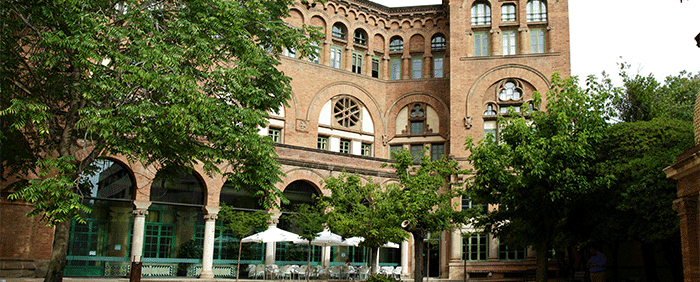
The venue is located in central Barcelona, just a 12-minute from the iconic Sagrada Familia.

Address:  
Autonomous University of Barcelona
Unesco Campus - Casa de Convalescencia
Carrer de Sant Antoni Maria Claret, 171, 08041 Barcelona


Campus History

The Universitat Autònoma de Barcelona (UAB), or Autonomous University of Barcelona, is a public university founded in 1968. It is highly regarded for its excellence in research and quality of teaching, consistently ranking among the top universities in Spain and internationally.

Key Characteristics and Strengths:

  1. Research-Oriented: UAB is a pioneering institution in fostering research, with numerous research institutes, centers, and technical support services on campus. It's closely linked to the ALBA Synchrotron Light Facility, a major scientific research infrastructure. Its research output is significant, with thousands of articles published annually.
  2. Comprehensive Academic Programs: UAB offers a wide range of academic programs across various fields of knowledge, including:
    1. Over 100 Bachelor's Degrees
    2. More than 550 University Master's Degrees, UAB Master's Degrees, and Graduate Diplomas
    3. Almost 90 PhD programs in five areas: Arts and Humanities, Health Sciences, Sciences, Social Sciences and Law, and Technological Sciences.
  3. Multidisciplinary Approach: Academic teaching at UAB is characterized by its multidisciplinary nature, closely linked to its extensive research activities. This integrated approach encourages cross-disciplinary learning and innovation.
  4. International Focus: UAB has a strong international vocation, attracting over 5,000 international students from 90 countries. It promotes mobility and collaboration, offering courses and programs in English and providing language courses for international students.
  5. Campus University: The main UAB campus in Cerdanyola del Vallès is a self-contained "city of knowledge" with nearly 50,000 inhabitants (students, lecturers, researchers, and staff). It houses most faculties, departments, institutes, and services within a natural environment.
  6. Innovation and Employability: UAB emphasizes innovation, entrepreneurship, and preparing graduates for the labor market. It manages nearly 4,000 internships annually and collaborates closely with the surrounding business and industrial community.

Rankings:

UAB consistently performs well in major international university rankings. For instance, in recent editions:

  • QS World University Rankings: Ranked 172nd in the QS World University Rankings 2026.
  • Times Higher Education (THE) World University Rankings: Ranked 199th in the THE World University Rankings 2025.
  • Center for World University Rankings (CWUR): Ranked 126th worldwide and first in Spain in the CWUR 2025 edition.

Faculties and Departments:

UAB is organized into numerous faculties and departments covering a broad spectrum of disciplines. Some examples include:

  • Faculty of Biosciences
  • Faculty of Communication Studies
  • Faculty of Education
  • School of Engineering
  • Faculty of Business and Economics
  • Faculty of Medicine (with teaching units in Barcelona and Badalona)

Departments such as Animal Biology, Cellular Biology, Biochemistry and Molecular Biology, Genetics and Microbiology, Audiovisual Communication and Advertising, Public Relations and Audiovisual Communication, Journalism and Communication Science, and many more.

UAB's research spans diverse areas, including:

  • Animal nutrition and welfare
  • Biotechnology and health
  • Social sciences and humanities
  • Materials and energy
  • Environmental sciences and sustainability
  • Information and communication technology

It hosts a wide array of research institutes and centers, some of which are:

  • Institute for Labour Studies (IET)
  • Institute of Biotechnology and Biomedicine (IBB)
  • Institute of Educational Sciences (ICE)
  • Institute of Environmental Sciences and Technologies (ICTA)
  • Institute of Neuroscience (INc)
  • Artificial Intelligence Research Institute (IIIA)
  • Catalan Institute of Nanoscience and Nanotechnology (ICN2)
  • Centre for Ecological Research and Forestry Applications (CREAF)
  • AIDS Research Institute (IRSICaixa)